Sorry, your browser doesn't support Java(tm).


 Our Organization

 Mission Statement

 Fire Stations

 Fire Investigation
 Task Force (FITF)

 Technical Rescue
 Team (TRT)

 Urban Search And
 Rescue (USAR)

 Fire Links

 Fire District 9
 Training

 Small Works Roster

 Vendor

 Surplus Equipment

 Fitness Tips

 Regional Training

 Job Opportunities

 Fire Prevention
 And Safety

 Major Incidents

 Firefighting History

 Fireman's Prayer

 Public Record Form

 Resident Firefighter
 Program

 District Photos

 Newsletter


Fire 9 Prevention Information Blog
to keep your house out of a fire incident report

Carbon Monoxide

Smoke Detectors

Home Fire Protection

Air Bags

Carbon Monoxide


"The leading cause of
poisoning deaths in America"


What is Carbon Monoxide ?
     Carbon Monoxide (CO) is a colorless, odorless deadly gas. Because you can not see, taste, or smell it, Carbon Monoxide can kill you before you know it is there.

Who is at risk ?
     Everyone is at risk for Carbon Monoxide poisoning. Experts believe, however, that individuals with greater oxygen requirements such as unborn babies, infants, children, senior citizens, and people with coronary or respiratory problems are at greater risk.

Why is Carbon Monoxide so dangerous ?
     The great danger of Carbon Monoxide is its attraction to hemoglobin in the bloodstream. CO is breathed in through the lungs and bonds with hemoglobin in the blood, displacing the oxygen cells need to function. When CO is present in the air, it rapidly accumulates in the blood, forming a toxic compound knows as caroxyhemoglobin (COHb).

Where does Carbon Monoxide come from ?
     Carbon Monoxide is a byproduct of combustion, present whenever fuel is burned. It is produced by common home appliances, such as gas or oil furnaces, refrigerators or clothes dryers, water heaters, fireplaces, charcoal grills, gas ranges, wood burning stoves, and space heaters. Fumes from automobiles also contain Carbon Monoxide and can enter a home through walls or doorways if a car is left running in an attached garage.

     All of these sources can contribute to a CO problem in the home. If a home is vented properly and is free from appliance malfunctions, air pressure fluctuations or airway blockages, Carbon Monoxide will most likely be safely vented to the outside. But in today's energy efficient homes this is frequently not the case. Insulation meant to keep warm air in during winter months can trap CO polluted air in a home year round. Furnace heat exchangers can crack, vents can become blocked, inadequate air supply for combustion appliances can cause conditions knows as backdrafting or reverse stacking, which force contaminated air back into the home.

How can I protect myself and my family from CO poisoning ?
     The Consumer Product Safety Commission (CPSC) recommends installing at least one Carbon Monoxide detector per household, near the sleeping area. A second detector near the home's heat source provides extra protection. Choose an Underwriters Laboratories (UL) listed detector that sounds an audible alarm. First Alert, the leading name in home safety, manufactures a UL listed, battery operated Carbon Monoxide detector that continues to protect even in the event of a power outage. The First Alert model uses patented biomimetic technology, which simulates the body's response to CO and will not respond to other gases. A hard wired AC model with battery backup is also available.

Common Sources of CO

  • Blocked chimney opening
  • Clogged chimney
  • Portable heater
  • Gas or wood burning fireplace
  • Improperly installed gas kitchen range or cook top vent
  • Gas clothes dryer
  • Operating barbecue grill in enclosed area such as a garage
  • Corroded or disconnected water heater vent pipe
  • Leaking chimney pipe or flue
  • Cracked heat exchanger

     If you have any further questions regarding Carbon Monoxide, contact your local fire department.

Information from First Alert


Smoke Detectors


Detector

     Its pure and simple, Smoke Detectors Save Lives.
This page will form a basis of what the smoke detector does and how you should use it.Smoke detector information provided from the
 

Photoelectric versus Ionization Detectors
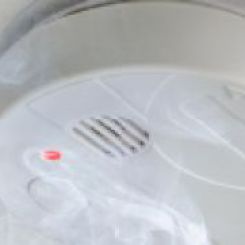
     Ionization detectors use a small amount of radioactive material to make the air within a sensing chamber conduct electricity. Smoke particles even smaller than the eye can see will enter the detector chamber and trigger the alarm. The greatest number of these small particles are produced by flaming fire resulting in the ionization detector to respond faster to open flaming fires than photoelectric detectors.
Photoelectric detectors use a small light source which shines its light into a dark chamber not normally exposed to light. This dark chamber contains a photocell to detect light. When smoke particles enter the sensing chamber, light is reflected off of them and into the sensing chamber. This causes the alarm to trigger. This method needs bigger smoke particles than ionization detectors which is usually formed from smoldering fires.

     Now which should I use? Even though the average particle size changes considerably with temperature, fires usually produce a broad range of particle sizes. Therefore, both types of detectors will detect most fires.

Installing Smoke Detectors
     Since smoke rises, smoke detectors should be installed on ceilings or walls between six and twelve inches from the ceiling. Avoid placing detectors high in corners where the wall and ceiling meet. Also, avoid installing detectors within three feet of an air supply register or return. Smoke could be pushed or pulled away from the detector by air flow. For further information, follow the manufacturer's instructions.

Escape Plan
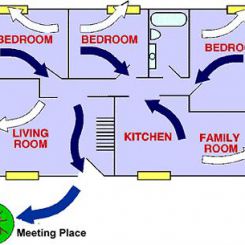
     This provides a brief overview of smoke detectors. However a smoke detector cannot put out a fire or get people out of a fire. All family members should know two exits from their home and preplan where you should meet once evacuated. Escape planning must be part of your smoke detector protection. The alternative is a false sense of security which can lead to tragedy.


Home Fire Protection


     These home tips for preventing fires are basic rules of thumb. In attempting to use a fire extinguisher to extinguish a fire, generally if the fire is bigger than the physical size of the fire extinguisher call the fire department. Anyway, always call the fire department after you've put out a fire to check that you have done everything to eliminate the cause.

     This page is broken down into two general categories. First and at the top of the page are more of personal safety. The second and nearer to the bottom are home tips on preventing fire and are further broken into categories of type of hazard.

     If you have any questions concerning fire prevention contact your local fire department.


3 Ways to Protect Your Family From Fire

  1. Install Smoke Detectors -- Smoke is responsible for 3 out of 4 fire deaths. The loud siren at the first sign of smoke will give your family those extra few minutes to escape safely. Test it once a month. Change batteries at least twice a year.
  2. Establish an Escape Plan -- Have frequent family meetings to establish escape routes from your dwelling. Every room should have 2 means of escape. Rope ladders are recommended for upper floor windows. Have practice drills every 3 months.
  3. Place Fire Extinguishers throughout the home
    • Type A : to extinguish wood, paper and fabric fires. Keep one in the garage and the workshop.
    • Type B : to extinguish grease, oil, gasoline, petroleum and other flammable liquid fires. Keep one in the kitchen, the garage and the workshop.
    • Type C : to extinguish electrical fires. Keep one in the kitchen and the laundry room.
    • Type ABC : for extinguishing all three types of fires.

Surviving A Large Fire
How to Get Out Safely

  1. Stay calm so you can think clearly.
  2. If door is closed, feel it from bottom to top, as well as the knob. If either is cool, you may open the door.
  3. Brace foot and shoulder against the door and open slowly. If there is light smoke, crouch low and crawl to the nearest exit with a wet cover over your nose and mouth.
  4. Stay low to avoid smoke/toxic gases that collect on ceilings.
  5. Close all doors behind you.
  6. Never use an elevator.
  7. Call the fire department. Never go back and get anything!

If You Are Trapped

  1. Don't panic! If you exert yourself, you will breathe faster and take in more smoke/toxic gases that can burn your lungs or cause you to become unconscious.
  2. Feel door from bottom to top and knob. If hot or warm, stuff clothing/towels in the cracks to keep out the smoke/toxic gases.
  3. Open a window at the top to let out heat/smoke collecting on the ceiling. Open window at the bottom and bend down to breathe in fresh air. Never open a window if smoke is rising from a lower floor.
  4. Stand by the window, waving something, and wait for rescue.

If You Catch Fire

  1. STOP where you are. Moving or running feeds air to the flames and worsens the fire.
  2. DROP to the floor. If you stand up, the fire can burn your face. Fold your arms high on your chest to protect your face.
  3. ROLL slowly on the floor or ground, or in a rug or blanket, if you can.
  4. COOL off as soon as possible with water for first and second degree burns. For third degree burns, seek medical attention immediately.

Home Fire Prevention
Electrical Fires

  • Electric Blankets, Heating Pads
    • Never fold or roll blanket -- heat will build up in wires, igniting blanket and rest of bed. Unplug and smooth flat when not in use. Don't leave a heating pad on for more than 30 minutes. Never fall asleep with it on. Set alarm clock to awaken in 30 minutes, if necessary.
  • Wires, Plugs & Extension Cords
    • Keep down the number of cords in one outlet or cord will overheat, causing sparks. Never run cords under rugs, behind radiators or across doorways where they can become worn. Have broken cords, switches making hiccup sounds, and hot plugs professionally repaired. Don't mask problem with electrical tape. Be sure to use proper gauge extension cord -- especially with power tools and high wattage appliances.
  • Fuses, Light Bulbs
    • Use only proper size fuse or circuit will be overloaded, wiring will overheat, deteriorate and start a fire. If bulb is to large, overheating can occur in cord, shade, socket, wiring or fixture, igniting combustibles.
  • Portable Space Heaters
    • Use one with thermostat (not just switch) that shuts off by itself when tipped over. Plug directly into own outlet. Use in area free of combustibles and well ventilated for heat escape. Never leave on overnight.
  • Clothes Dryers
    • Never leave synthetic fabrics, plastics, rubber or foam in the dryer for longer than the manufacturers recommended time. Clean lint screen before and after use. Keep area free of combustibles. Dryers must be vented to outside and plugged into own outlet.
  • Personal Grooming Appliances
    • Hair dryers, curling irons, hot rollers, makeup mirrors, and electric razors must be away from combustibles while in use. Disconnect after use. Never fold/crimp cords or insulation will be ruined, exposing wires which can short out and spark.
  • Vaporizers
    • Never leave vaporizer unattended or near combustibles. Keep water level ample. Check that cord at the plug is not too hot. If it is, disconnect immediately. Use in own outlet or with heavy-duty extension cord.
  • How to fight small electrical fires
    • Switch off appliance and pull out plug. Smother fire with blanket or Type C extinguisher. Never try to cool with water because water conducts electricity and can give you an electrical shock.

Cooking Fires

  • Greasy Pan
    • Never heat cooking oil and leave room. A flame can ignite spontaneously! Keep combustibles away from stove, especially loose sleeves or scarves. Hot grease can spatter and ignite any paper, cloth, or wood materials nearby.
  • Fire In Oven
    • Avoid letting grease build up in any part of oven. A greasy broiler can catch fire even during preheating. If there is too much fat on a piece of meat, the grease can flare up and start a fire.
  • How to Fight Small Cooking Fires
    • Shut off stove or oven, smother pan with lid/Type B extinguisher or baking soda. Smother fire in oven by keeping door closed and/or throwing baking soda on food. Never Move Pan. It will fan the fire or spatter grease. Never turn on the exhaust fan or use water. Fan will draw up flames. Let fat cool in oven or else contact with air may make fire flare up again.

Gas Fires

  • Leaking Gas
    • Never enter an area with a lighted match or cigarette if you smell gas from a pipe, heater or stove. The smallest spark or flame could ignite gas in the air and cause an explosion.
  • How to Fight Small Gas fires
    • Shut off gas supply. Smother with rug, blanket or Type B extinguisher or cool with water. Ventilate the area to let gases out. Call Fire department always to have the area pipes checked for further hazards. Then call the gas company. Note: if there is a gas fire, it may be better to let the gas burn rather than extinguish the fire which would let the gas fill the room or house creating the potential for an explosion. Therefore, the primary key is to shut off the gas supply and call the fire department.

Storage Fires

  • Oil Soaked Rags
    • Dry out by spreading in a well ventilated room so heat can escape, then wash. Never put oily rags in a pile because they can ignite themselves. Store in labeled metal containers sealed with a tight lid.
  • Barbecue Charcoal
    • Store unused coal in a cool, dry place because damp coal can ignite itself. Use metal pail/garbage can with tight lid and place in open space where heat can escape if self-ignition should occur.
  • Flammable Liquids
    • Never use or store in room with pilot light, or to close to hot light bulbs because vapors in air can easily be ignited. Store in cool, dry room in labeled metal containers with tight lid.
  • Stacks of Newspaper
    • Avoid storing in a damp, warm place because newspapers generate heat and can ignite themselves. Store in cool, dry place at least 3 feet away from any heat-generating source, such as a pilot light.
  • How to Fight Small Storage Fires
    • Smother with blanket or rug to cut off air supply. Use Type B extinguisher for rags, charcoal, liquids/solvents, hair spray/glue and Type A extinguisher for newspapers.

Heating Fires

  • Fireplace Wood Stoves
    • Use only dried woods (less smoke, dirt), never flammable liquids. Dispose of cool ashes in lidded metal container. Never leave fire unattended. When burning, keep damper open, keep flammable material away and glass door/screen closed.
  • Furnaces, Radiators, Water Heaters
    • Install properly and safely away from walls and ceilings. Never put combustibles on or near units. Keep ducts and filters dust-free by cleaning several times a year with unit shut off.
  • How to Fight Small Heating Fires
    • Call the fire department if stove pipe is red or fire is in chimney. For furnaces, radiators, water heaters, immediately shut off. Smother if electrical, only use water/Type A extinguisher if gas fired. Drown fire in fireplace with baking soda, water or Type A extinguisher up chimney.


Air Bags


The Air Bag That Saves Your Life
Could Kill Your Child

Vehicle CrashAn air bag deployed in this vehicle during the initial collision. The driver was wearing a safety belt with shoulder harness also. Only minor injuries occurred for the occupant.
Do you think it helped?


Deployed Dual AirbagsPictured here are dual airbags after deployment.


Air Bags and Children :

     The National Highway Traffic Safety Administration (NHTSA) recommends placing all children 12 years old and younger in the back seat. This is the safest place in the vehicle. Each child should be properly restrained using a child safety seat or safety belt, depending on his or her size. Never put an infant in the front seat of a passenger side air bag equipped vehicle.

     If a child must be placed in the front seat of a vehicle equipped with air bags,

  1. the seat needs to be pushed all the way back;
  2. the child needs to sit with his or her back against the seat back; and
  3. the child should be buckled securely with minimal belt slack.

This will reduce forward movement in a crash and maximize air bag effectiveness.

Air Bags and Short, Elderly or Pregnant Persons :
All drivers and passengers should do the following :

  • Always buckle up, with slack at a minimum;
  • Sit as far back as possible, tilting the seat slightly rearward;
  • Adjust the tilt steering wheel toward the chest; and
  • Hold the steering wheel from the sides.

     Short, pregnant or elderly vehicle occupants who follow these recommendations will maximize the life saving benefits of air bags and safety belts.

FAQ About Air Bag Related Injuries and Children

DANGER TO CHILDREN
Question:
    
Why are air bags dangerous to children age 12 and under?
Answer:
    
Air bags inflate at speeds up to 200 mph. That blast of energy can severely hurt or kill passengers and drivers who are too close to the air bag. An infant's head in a rear facing safety seat is directly in front of the air bag as it breaks through the dashboard and instantly inflates. Even some forward facing child safety seats could possibly place the child within range of the air bag before it is fully inflated. Also, if a child is unbelted, or to small for the lap and shoulder belts to fit properly, or wriggling around or leaning forward, there is a danger that the child will be to close to the dashboard during that instant the air bag begins to inflate.

IMPORTANCE OF SAFETY BELTS
Question:
    
How can an air bag work so well for adults, but hurt children in the front passenger seat?
Answer:
    
An average size adult who is correctly belted is not likely to come in contact with the air bag until it is fully inflated. A fully inflated air bag spreads the force of the crash across a wide area of the body. Even an unbelted adult will probably come in contact with the air bag at the chest area after the bag has at least partially inflated. For greatest protection, both the driver and front passengers should be correctly belted and the seats moved back as far as practical to allow ample space for the air bag to expand.
Unbelted or improperly belted children can easily slide off the seat during pre-crash braking, throwing them against the dashboard where the air bag can strike them on the head or neck with tremendous force before it is fully inflated.
The air bag only inflates in front end crashes and collapses immediately. For protection in all types of collisions it is very important to always use both the lap and shoulder belts.

BEING SMOTHERED BY AN AIR BAG
Question:
    
Is it true that a passenger can be smothered by an air bag?
Answer:
    
No! The injuries that occur are caused by the inflating bag hitting the head and neck of an out of position passenger or the inflating bag hitting the back of an infant seat behind a baby's head. The air bag loses its air right after it inflates, so the stiff fabric does not remain over the passenger's face.

Information Provided From NHTSA

For More Air Bag Information see the NHTSA Web Site.


Spokane County Fire District 9
3801 East Farwell Road
Mead, Washington 99021
Phone: (509) 466-4602
Fax: (509) 466-4698
E-Mail: admin@scfd9.org

Copyright © 1992 - 2008 Spokane County Fire District 9.

Site Created by Fire Creek Photography and Design Studio